Friday, August 30, 2013

Sixty days to Halloween

One day soon Owen is going to stop making things out of every box that comes in the door and I will be sad.
Everyone in the the household under the age of 17 is back in school as of yesterday. I let so much material pile up without posting that I must now resort to a list just to clear the decks.

-This Food52 ceviche is lovely. Halibut is expensive and the piece I bought came attached to skin which made it hard to cut the meat into neat cubes unless you’re really adept at skinning fish. I’m not. In future, I’d buy something skinless and less costly. I initially wrote “skinless and cheaper” but the word “cheap” is a turnoff when discussing fish, as is the word “grey.” In the Time/Life Cooking of Latin America the ceviche recipe calls for “grey sole” and I frowned and turned the page. Irrational. The really beautiful part of this particular ceviche is the watermelon. You think you're just eating a melange of fish and soft red tomato and then you get a bite of crisp, intensely sweet red watermelon. That’s as exciting as eating salad ever gets. Inspired by the excellent ceviche, I tried making this tomato and watermelon salad last night and it just didn’t work for me. Soggy. Since we now had watermelon around and I’m apparently on a Food52 kick, I also whipped up a batch of their boozy watermelon rosemary lemonade in the Vitamix and it was refreshing and not especially intoxicating, which I appreciated.

-Yes. I bought a Vitamix. That's the box in the picture above. My sister picked it up at Costco and it was a pretty good deal, though I'm not sure any Vitamix is precisely a "good deal" unless you inherit it. We’ve used the Vitamix to make milkshakes, creamy alfredo sauce, frozen margaritas, and the aforementioned boozy watermelon lemonade and while I’ve not yet made a kale smoothie, it's true that the minute you buy a Vitamix you start thinking about kale smoothies. I was going to wait to buy the Vitamix until the end of the year and see if the desire passed, but it was preoccupying me to the point of obsession. As Oscar Wilde said, “The only way to get rid of temptation is to yield to it," and while that didn’t work out so well for Oscar, I think it’s sound advice, certainly when what you're talking about is the purchase of a blender. There’s no point in obsessing about a blender for months if you can just go buy the blender and free your mind up to obsess about other things. Like date ice cream. I've always wanted to make date ice cream and I think with a Vitamix this will at last be possible. 

-I was reluctant to end my allegiance of 20 years to Katharine Hepburn's brownies, but this brownie recipe from The Essential New York Times Cookbook is a knockout. I should be glad that I can now bake even tastier brownies, but discovering this recipe was wrenching and unsettling and I feel disloyal to the Katharine Hepburn brownies.

I'll get over it.

Friday, August 23, 2013

And we're home


Home from Peru.

But before that we spent three nights at a lodge on the brown Tambopata River where we saw capybaras (the world's largest rodent), a few caimans, several tarantulas, macaws eating clay from the side of a cliff, and carpenter ants. 

With the exception of winged insects, the wildlife was surprisingly sparse. The animal viewing here in Marin County is better, with more variety, quantity, and proximity, and when we spent 20 minutes watching some deer through binoculars, I wanted to laugh. 

We had fun anyway. Andes = cold and tense. Jungle = hot and relaxed. 

At the lodge we ate causa for the first time. Imagine a terrine of cold, tart mashed potatoes, creamy fish, avocado, and black olives. Cold, tart mashed potatoes. Sounds awful, but it was very, very delicious.

And then there were the pisco sours.

Drinking is no fun when your only companions are Owen and his iPod Touch, so I hadn’t been observing cocktail hour. But after two weeks of watching other tourists drink pisco sours, I finally had to order one. I loved it. What a surprise. The pisco sour is tangy, soft, and rich, as opposed to the margarita, which is tangy, lean, and sharp. The last two nights of the trip I drank pisco sours and they were the best nights of the vacation though not because of the pisco sours. They were the best nights of the vacation because I made friends. At the lodge, I met two delightful Englishwomen, Lorna and Maggie, and over the course of three days the word "bigot" never once came up. I was as sad to part with them as I was relieved to see the last of Ann.

Maggie convinced me I need a Vitamix. She makes Stilton and broccoli soup in hers, a dish that has taken on a life of its own in my head. Doesn't that sound great? I’m pretty sure I'll make Stilton and broccoli soup in the blender before I can justify buying a Vitamix, but I also know that one of these years I'll probably buy a Vitamix. 

Sunday, August 18, 2013

Guinea pig meat, coca tea, cob ovens

Although I don't have a big soft spot for guinea pigs,  I was unable to relish their meat.
This is our last hour in the high-altitude, non-jungle part of Peru before we spend a few days at a lodge where they turn on the electricity only sporadically and we will sleep under mosquito nets in a world of tarantulas, caimans, malaria, and sloths. After that: home. To summarize our visit to Andean Peru, focusing on the food:

-I wasn’t going to eat guinea pig, but when it appeared as a confit on a menu, I had to order it. Rich oily, salty and gray, it could have been duck or rabbit. But it wasn’t. After a few bites, I gave up. I had a guinea pig when I was 12. Her name was Esther. We went to a pizzeria last night that served a guinea pig-stuffed calzone, but I was able to resist.

-pizza. Lots and lots of very good pizza in Peru, usually baked in a cob oven. Cob ovens are everywhere.

This was the most impressive cob oven we saw.  We bought a delicious cheese empanada here and when I get home and plaster our own cob oven, I'm going to try making empanadas.
-starches! A typical plate in Peru contains both rice and potatoes. Sometimes corn, too. There is also a lot of bread and while it is freshly baked, it is very bland. I have encountered few green vegetables and have begun to crave them. I’m definitely fatter than when we came.

-The local cheese resembles fresh mozzarella in its texture, but it's salty and it squeaks when you eat it. We’ve had it cold, melted, grilled, chopped up in soup, and folded into empanadas. I love it. 

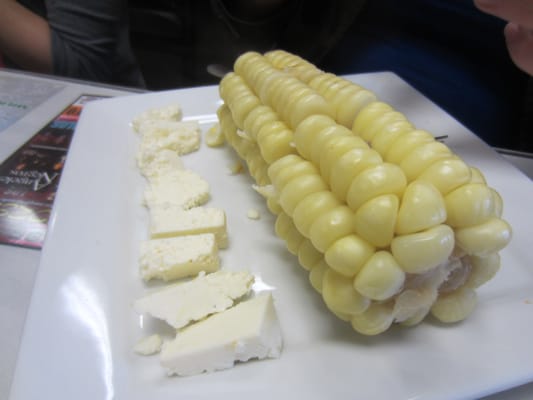
-Choclo is a very pale, beautiful, fat-kerneled corn-on-the cob that is sold straight out of pots of boiling water on the street and I regret that I never got around to tasting it. Nor have I eaten ceviche or drunk a pisco sour.

-Coca. Peruvians swear by the curative properties of the coca leaf and use it in tea, cookies and candies. It doesn't make you high. I drank coca tea and it was fine. I ate a coca cookie and it was a waste of cookie calories.  Peruvians say coca cures altitude sickness, but the only thing that helped Owen was the prescription drug we brought with us. 

-Speaking of Owen, he has been an excellent companion. Our only conflicts have involved his iPod touch. He starts playing a game and can’t stop and I have to rip it out of his hands to get him to leave the room. Also, I can get frustrated by his eating habits. At meals, which I spend the whole day looking forward to, he hunches over his plate and devours everything within 3 minutes and then says, “Can we go now?” Even so, by far the best part of the Peru trip has been his company. 

Saturday, August 17, 2013

The strange day in Peru, part II


Owen, dancing on Taquile Island
This second chapter has been hard to write as it touches on race, class, religion, and politics, and culminates in a perplexing emotional detonation. But a promise is a promise. 

Ann and Beth (pseudonyms) were the only other Americans on our very touristy boat tour of Lake Titicaca, the vast body of water straddling Peru’s border with Bolivia. We met on the Uros island described in the last post and cemented our friendship back on the tour boat as it motored on to Taquile, the other island on the itinerary. Owen and I gave them hand sanitizer. They gave us hard candies. 

I could tell immediately that Ann was a woman of great emotional intensity, a compulsive oversharer, what you might call a “live wire," probably a little nuts. I liked her a lot.

Ann’s 15-year-old daughter, Beth, was as serene as her mother was excitable. That probably wasn’t a coincidence.  An avid reader, she was carrying around a copy of Khaled Hosseini’s And the Mountains Echoed and we chatted about that and other novels we’d both read. She was one of those rare teenagers who talks to adults like they’re human beings and I liked her as much as I liked her mother. 

Owen’s role: genial bystander. 

Taquile Island, home of the Aymara people, is how I imagine Corsica. It rears up out of the blue-green lake, dry, rocky, and scrubby. Sheep grazed on hills that were gridded with orderly stone walls and dotted with huts. The people wore bright, traditional clothes and they looked prosperous and clean, the children appeared well cared for. (Unlike the Uros people, the Aymara seem to live very long lives.) We hiked 20 minutes up a steep stone path to the town square and I learned a great deal very quickly about Ann: long ago fertility troubles, Beth’s devastating decision last year to spend more time with Ann’s ex-husband, etc. The torrent of confidences was peppered with vehement political comments that did not always resonate with me. Restrictive zoning laws were a particular source of fury for Ann, as was public school funding, and “liberals who get angry when you idle your car.” I mostly just smiled vaguely in response.  We were on a gorgeous island in Peru and I had no interest in arguing.  

At some point, the tour guide ushered us to an Aymara home for an “authentic” Aymara meal. It felt about as authentic as a llama keychain, but was a lovely and happy experience nonetheless.  There was some music and dancing and for the meal we sat at long picnic tables on a patio with a lake view. We were served first a ceramic bowl of thin quinoa soup and then grilled trout. “The Aymara don’t have a source of salt and sugar, so they use very little in their cooking,” explained the tour guide. This was self evident. It is surprising how delicious bland food can be.

Owen and I sat next to Ann and Beth, of course. I wish the conversation had been recorded so I could play it back and analyze exactly how the little drama unfolded. I was only paying half attention and when I tried to piece it together after the fact there were whole chunks missing. What follows is not verbatim, but gives the gist. 
At a certain point in the meal, Ann started describing the resistance among (white) people in her state, including herself and Beth, to learning Spanish. It had something to do with the fact that almost all the Spanish speakers they met were Mexican maids and gardeners.  Somehow it just didn’t make you want to learn the language, said Ann, when all the people who spoke it worked in service. 

Whoa! I thought. Candid! I suspect the “maids and gardeners” bias explains the incredible popularity of French in our own school district, but no one has ever come out and said as much. Ann seemed to be grappling earnestly for a way to explain the anti-Spanish bias and I decided to help. 

“Because it seems lower class?” I said. I actually thought I was bringing clarity to the topic. In this context, wasn't “lower class” a useful synonym for “maids and gardeners?” Hadn't Ann essentially said it herself?

For the record, I think this anti-Spanish bias is silly and short-sighted. Plus, my maternal grandmother is a native Spanish speaker from Latin America. But I don’t think there was judgment directed toward Ann in my “lower class” remark. I know I didn’t intend any. 

This conversation soon petered out.

A few minutes later Ann said a propos of I can’t remember what: “A Latter Day Saint boy was interested in Beth and I don't want her to have anything to do with him.”

“No?” I said cautiously. “Why not?” 

“I just don’t want her going down that road,” said Ann. “It’s dangerous.”

Whoa. Candid.

I couldn’t let this pass. I said, “I should tell you, my father’s family was all LDS. I don’t think it’s dangerous to date a Mormon.” I said this lightly because I was starting to suspect that Ann was not just a live wire but a loose cannon. 

“It’s playing with fire!" said Ann fiercely.

Beth looked like she wanted to crawl under the table. I said, “Is the LDS boy your boyfriend?”

Before she could answer, Ann said loudly and stiffly: “No! We're not going to discuss that here! Let’s change the subject! Maybe we can talk some more about how I’m a bigot because I don’t jump on the Spanish bandwagon.”

Then Beth shook her head and said sorrowfully, “I’m definitely not a bigot.” The two of them climbed out of the picnic table and left Owen and me sitting there.

On the hike back down the hill to the boat we were 12 steps in front of Ann and Beth the whole time. We could overhear them and they could overhear us and while they talked animatedly, everything I said to Owen sounded stiff and forced. Why was I was the one feeling awkward when Ann was the narrow-minded hothead? 

On the boat back to the mainland,  I went over the interaction with Ann and Beth again and again. What had happened? What had I said or done? Bigot? Where had they come up with bigot? It hadn’t even crossed my mind. We disembarked and didn’t say goodbye to Ann and Beth, nor they to us. 
Back at the hotel, I went straight to the internet and looked up the definition of “bigot.” I had always thought it meant “racist,” which it does. But the Merriam-Webster definition is broader than that: 

Definition of BIGOT
: a person who is obstinately or intolerantly devoted to his or her own opinions and prejudices; especially : one who regards or treats the members of a group (as a racial or ethnic group) with hatred and intolerance 
I don’t think Ann was a racist. But take out the “especially’ clause and there’s no question she was a bigot.

After a thorough review that lasted well into the next day and involved a long conversation with Owen, who had observed the incident, I concluded that Ann was off her rocker and that I had behaved acceptably. Owen, however, argued that I should have disagreed with Ann the first time she said something objectionable. He said the only way to have a real relationship with someone is to lay your cards on the table from the start and if it’s not going to work out, you’ll know right away. (He just read this over my shoulder and says he's fine with me making him sound more articulate than he actually is.) I countered that you have to pick your battles. Moreover, if I’d disagreed with Ann earlier I would have ruined the whole afternoon, not just the last hour. 

But perhaps Owen is right. 

We left Lake Titicaca the next day and went to Cusco where we saw a cathedral that features a painting of the Last Supper with a guinea pig on the platter. We ate pizza topped with alpaca prosciutto followed by delicious, delicious alfajores and I sat on a park bench in the sun and read an excellent Peter Abrahams novel. Day before yesterday, we visited Inca houses built into the sides of cliffs and yesterday we hiked around Macchu Picchu and decided not to climb Huayna Picchu because we are scared of slipping and plunging to our deaths as people occasionally do. For dinner I ordered guinea pig confit. This morning I'm trying to decide whether one of my friends would ever wear a baby alpaca wool poncho and am thinking probably not. All of this has been enjoyable (except the guinea pig confit), but none of it has challenged my assumptions or forced me to think like that sad morning on the island of the Uros and the confusing afternoon with Ann. I hope the last few days of the vacation continue in this pleasant and unchallenging vein.

Tuesday, August 13, 2013

A very strange day, part 1

It's like a painting.
The highs of this Peru vacation are very high and the lows are quite low, but at least those lows are interesting. In this case, more interesting than the highs. The highs are as follows: terraced landscapes, quinoa cream soup, creamed quinoa, quinoa pancakes, vicunas, embroidered textiles, alpacas, Inca ruins, giant hummingbirds, Arequipa.

Let me assure you the good outweighs the bad and I should write about the good in more detail and there is some good woven into the perplexing day I'm about to describe. But mostly it's not good. If you have come here just for cooking, please don't read any further.  My mother would have said, "No one wants to read things like that, Jennifer!"And some of you won't.

There are also distasteful pictures.

Without further ado:

Lake Titicaca sits on the border between Peru and Bolivia and it is a beautiful, big lake with many islands. Among these islands are roughly 50 manmade floating islands that are home to the last of a  pre-Inca people called the Uros. Many centuries ago the Uros figured out how to build mobile islands out of reeds and they moved, en masse, on to the lake to escape their enemies. They built houses on these floating islands and lived on fish and waterbirds. Some still do. Sort of.

There are tours to these islands and who could resist? The travel literature makes the islands sound fascinating, if touristy.  Apparently, some Uros just come over in boats and act out the traditional lifestyle for visitors. I was prepared for the fake and touristy.

But as we motored out of Puno harbor, our guide assured our group of 20 that the island we were visiting was more authentic than the tourist traps we might have read about.

And I believe him.

This nameless island was further out in the lake than the others, about an hour out from the harbor. The boat pulled up to a floating mass of reeds about the size of, I don't know, a basketball court. Maybe a little bigger. On this mat sat a handful of reed huts. It was one of the strangest things I'd ever seen and I thought it was pretty cool as we stepped out of the boat onto the spongy bed of reeds. You could feel the ground sink under your feet. We were greeted by a group of maybe 15 beaming Uro men, women, and children. All of the women were enormously fat and all of the men thin. I don't understand that. Their clothing was noticeably soiled and you could take that in at a glance. One of the men gave a little presentation about how they build the islands (way over my head) and then we were free to roam around, ideally to purchase some of their overpriced weavings that I do not believe for one second were made on the island. But who cares where they were made. That's beside the point.

In the quadrant of the island dedicated to food preparation, there were some large gray waterbirds tied to a wooden cage and more birds inside the cage. According to the tour guide, they are a variety of kingfisher, the eggs of which the Uros eat.


The stench in the area was powerful and deeply, deeply wrong. An Italian woman and I stood looking at a seemingly abandoned tub of potatoes half submerged in murky liquid along with some mysterious smaller tubers. Or something.


Beside them lay a dead, fully feathered bird and nearby a brace of plucked, rotting birds, probably the source of the odor. Tourists were walking over and around the birds.


An energetic small child was playing nearby and she was playing the same games children do all around the world, emptying and filling vessels. At some point, her sister or cousin, a child of 4 or 5, picked up a reed from the ground and started chewing on the white end. The tour guide said, "Oh, those are the bananas of the Uros."


The other children seemed healthy, but this particular girl's nose was pouring and she had a rattling cough. The islanders have a life expectancy of 54 as opposed to 74 just across the water.

Poverty is terrible. What made this particularly terrible was a. that cynical tour companies bring people here and bill it as a look at a unique ancient culture and b. that these particular Uros seemed to have no idea what a degraded spectacle they made. They were beaming, fawning, trying to sell faked weavings for which they charged unreasonable amounts of money. I would have preferred it if they had been sullen and cold like some of the indigenous people we encountered elsewhere.

I'm not personally sorry that I was brought to this sad island. I'm glad. It was a memorable, depressing glimpse of the awkward and ugly transition between a traditional way of life and the 21st century.

Supposedly the Uros are flocking to the mainland in droves and I wish them godspeed.

Anyway, at some point, we were herded into one of the narrow, low reed boats, where a big group of us sat uncomfortably on the floor as one of the men rowed us very slowly in a circle. We paid $3 for this. While we were on the boat I struck up a conversation with the only other Americans on the tour, but that upsetting and short-lived friendship, which unfolds a few hours later on another island, a beautiful island, I am saving for installment two.

Friday, August 09, 2013

In the land of potatoes


There will be a short hiatus from Time-Life cooking as I do some traveling inspired in part by those very books many decades ago.

It's the time of year when Owen and I take an ambitious vacation. Or at least this is what we did the last two summers and since we both have quasi-sacred memories of those trips, there didn't seem to be any reason not to try again. In fact, it seemed wrong not to. We are in Peru.

Do you know how many foreign nations I had visited when I was Owen's age? Zero.

They are everywhere.
I hadn't done any research on Peruvian food (too busy with flummery?) and it is . . . my storehouse of adjectives is failing me. I've wasted "outstanding" and "superb" on things like flummery and what's left for the otherworldly cuisine of Peru? We're in the city of Arequipa, famous for its cooking and rightly so. I've eaten peppers stuffed with ground meat, olives, and local cheese and at another meal a dish of potatoes covered with a creamy sauce in which there were small chunks of fresh cheese. Both dishes were wonderful and unlike anything I'd ever tasted and I've tasted a lot. For lunch yesterday, Owen ordered guinea pig, a specialty of the town. You can get it fried whole and gruesome, but we went to a restaurant where they serve it demurely sliced on bowl of quinoa and he ate with gusto. (I was willing to forgo cuy, but he was not, one of many examples of my senescence and his surging vitality.) I ate a bowl of chupe de camarones, the local shrimp soup, and the serving was so huge I thought I'd leave an embarrassing amount but predictably to anyone but me, I ate every bite of the rich pink broth, the giant prawns, starchy corn, sweet winter squash, and floury potato. That was lunch. Dinner was unthinkable.

There is so much more to report, but we're momentarily leaving on a long drive up into the Andes. I've read far too much about altitude sickness for my excitement to be unmingled with dread. Sometimes I think I must prefer it that way.

Monday, August 05, 2013

New ways to eat your colors


I made the strangest, loveliest soup last night. If you scroll down here, you'll find a reprint of the recipe for kesakeitto, a Finnish vegetable soup that is unlike any soup I've ever made. (Source: The Cooking of Scandinavia, Time-Life.) You quickly poach many vegetables (string beans, cauliflower, carrots, spinach, potatoes, peas, radishes) in water, which becomes a very light broth. Then you add milk, a little cream, and some shrimp and cook but briefly. The resulting soup has a consistency and color -- brothy and milky -- unknown in American chowders and soups. This will sound completely unappetizing, but it reminded me of what happens when you add too much milk to herbal tea. Except the soup, unlike the tea, is delicious and full of flavor. If I were to improve this, I might add some rice to thicken it just a bit, but I'm not even sure I'd do that. Try it. The recipe says the shrimp is optional ("a touch of luxury on special occasions"), but I wouldn't leave it out.

That's dill on top.
Here is the enchanting passage in which the soup is introduced in the book:

"If you are looking for a blunt, outspoken dish, look no further than slaughter soup -- the kidneys, liver, heart and meat of an animal, chopped up, boiled with carrots and potatoes and served with little barley and wheat dumplings flavored with blood. Almost as though to compensate for such ruggedness, there is a delicate soup, kesakeitto, made from summer vegetables. . . picked at their absolute peak of freshness and simmered in a creamy base. This soup is much favored by Finnish women, who think they are dieting when they eat it -- but with their consciences thus eased, usually go on to finish the meal with several small pancakes and strawberry jam."

Or, in the case of an American woman, strawberry shortcake. Recent comments on the blog made me crave shortcake, so I tried the recipe from American Cooking. Although this is not a salty, pie crusty type of shortcake, it is stellar. A sweet, pillowy biscuit sandwiching barely sugared strawberries. As Owen wolfed it down he said, "Make this again, exactly like this."


Strawberry shortcake (adapted from American Cooking)

I halved the recipe. I also found that when I baked the little biscuits atop the big ones, they browned deeply on the outside before their doughy middles were done. I would bake them separately, although this could make them a little too crusty. Just be sure not to overbake and I think all will be well.

4 cups all-purpose flour
6 tablespoons sugar
5 teaspoons baking powder
2 1/2 teaspoons kosher salt
12 tablespoons unsalted butter, cut into bits and chilled
1 1/2 cups heavy cream
2 tablespoons melted butter (sated butter would probably be good here)
2 pints strawberries, coarsely chopped; reserve 6 whole berries for tops of cakes
sugar for sprinkling berries
1 pint heavy cream, lightly whipped for topping

1. Preheat the oven to 450 degrees F. Sift the dry ingredients together in a big bowl. Add the cold butter and rub it into the flour until you have a coarse meal. Add the liquid heavy cream and stir until a dough is formed. (This dough is delicious.)

2. On a lightly floured surface, roll out the dough a scant 1 inch thick. Cut 6 circles with a 3-inch biscuit cutter and then cut the rest of the dough with a 2 1/2-inch cutter. You will have to reroll scraps to do this.

3. Place the biscuits on a cookie sheet and brush lightly with melted butter. Bake for 12-15 minutes until golden. Don't overbake.

4. When they've cooled a bit, place the larger biscuits on dessert plates. Spoon the berries over the larger biscuits and sugar the berries to taste. Top with the smaller biscuits, then top the smaller biscuits with whipped cream and the whole berries. Serves 6 very, very amply.

Sunday, August 04, 2013

Smitten Kitchen: Earnest Summation


As you may recall, a few months ago I spent some time cooking through The Smitten Kitchen Cookbook. I always get around to the cookbook summaries eventually, if not in the timely fashion I originally intended.

There's a disconnect between Deb Perelman's tastes and mine. I was looking through the book this morning trying to put my finger on it, but there is no single "it."

I'll start with the first difference that jumps out: There are people who love brunch and there are people who don't and Perelman clearly falls into the former category. The breakfast chapter is one of the longest in her book and it is full of eggy, starchy dishes that serve a sociable crowd, i.e. brunch foods.

I am not a brunch person. It is 6:42 a.m. on August 4 as I type these words and I am fully dressed, drinking coffee, crossing items off my to-do list (including this post) like the insufferably peppy morning person I have always been. I can not imagine anything less appealing than waiting until 11 to drink mimosas and eat a slab of New York breakfast casserole. This isn't a value judgment, it's a difference in biorhythms.

But I also can't imagine anything less appealing than New York breakfast casserole at any time of day and that isn't a difference in biorhythms, it's a difference in taste. New York breakfast casserole is a savory pudding of bagel chunks, cream cheese, eggs, and half-and-half and nothing about that makes my mouth water. I'm not saying my taste is superior. Flummery? Just different. A lot of Perelman's dishes are, for want of a better word, dense. Chocolate chip brioche pretzels. Fig, olive oil, and sea salt challah. Cheddar swirl breakfast buns. These do not tempt me at all.

It sounds like I'm panning the cookbook. I'm not. Because where our tastes overlapped, I was consistently delighted. The dishes I loved from this book, I really, really loved. Broccoli salad. Red wine chocolate cake. Avocado tartine. Gnocchi in tomato broth. Eggplant and three cheese calzone. Grapefruit olive oil cake. Now that it's summer, I want to dip back into the book and try the peach dumplings with bourbon hard sauce. They look fabulous and I'm sure they are. I don't, however, want to try the tomato shortcakes with whipped goat cheese or the corn risotto-stuffed poblanos and that's the taste issue again. I can happily overlook it. Four dishes that are worth the price of the book? That's a shelf essential.

I cooked 31 dishes from The Smitten Kitchen Cookbook and here's how I'd rate them:

worth the price of the book: 4
great: 6
good: 12
so-so: 8
flat-out bad -1

The one dish that I deemed "flat-out bad" was possibly "bad" due to an error on my part. I doubt the gooey cinnamon squares are really flat-out bad because Perelman doesn't publish bad recipes. But my rule has always been that if can't figure out what I did wrong, I go with the results. I could not figure out what I did wrong and these were too sweet for anyone in this house and some of us like shoofly pie.

Friday, August 02, 2013

Cornish pasties


'Cornish pasty' is one of those terms I don't like to speak aloud because if I pronounce it correctly people might think I'm mispronouncing and if I pronounce it incorrectly they might think I'm ignorant. You just can't tell until they say it themselves.  For the record, you pronounce it like this. Like nasty.

When I went to buy the the beef for the pasties, the butcher said, "What are you making?"

I said, "You know, those Cornish. . ."

He said, "Oh Cornish pasties. I made those about a month ago." He pronounced it like you'd pronounce "pasty" when describing someone's complexion.

Then we talked pasty crusts. He made his with Crisco and shared a long description. I didn't tell him I was going to make mine with lard because I didn't want him to feel unmanned. The lady customer is using lard and I, the big butcher, used Crisco?

You can have no idea how I pined for pasties when I was a kid flipping through American Cooking: The Eastern Heartland. That spread was one of my all-time favorites. You can't easily tell from my photograph of the photograph, but if you look closely at the middle photograph on the right you'll see they placed the pie on a shovel for the shot. Miners in Michigan supposedly used to put their pasties on shovels and then heat them with the candles in their head lamps. Do you believe that? Could a candle really heat a pasty through a shovel? Wouldn't that take several hours?

So I made the pasties and they were tasty and not hard at all. Here's a recipe that's very close to the recipe in the book. For the record, I used a turnip, not a rutabaga, and did not apply an egg wash. I halved the recipe and the pasties still fed three of us for three nights in a row, so be aware that this is a lot of hearty food. We had more filling than dough, and after the first night I fried the leftover filling like hash for myself and let the males in the house eat the actual pasties because they seem to have faster metabolisms. It was delicious hash. The pastry is like packaging and you don't need that when you're eating at home.

Verbatim conversation with Mark this morning as I sat at the computer trying to write this post:

J: "What did you think of the pasties?"

M: "The meat pies?"

J: "Why don't you say 'pasties?'"

M: "Because that sounds like a gross word. But then meat pie does too. It was pretty unattractive, the meat inside looked like dog food, but it tasted really good. You're a good cook."

Tuesday, July 30, 2013

Hamburgers a la Lindstrom and shoofly pie


I am so happy in my cooking life right now. Revisiting these Time-Life books is a great sentimental pleasure.

Two dishes:

-Hamburgers a la Lindstrom from The Foods of Scandinavia. I had to make these because of the name. According to author Dale Brown, in Sweden meat used to be so tough that cooks typically ground it up and made meatballs (which explains Swedish meatballs) and so-called hamburgers like these -- "a piquant and juicy blend of beef, finely diced beets, chopped onions and capers." Mark thought they smelled like fish and was very suspicious. Owen ate with gusto and announced that he loved the dinner. I liked these meat patties fine, but won't make them again. Meatballs are better, as is meat loaf, as are ordinary American hamburgers.  (Isabel is away at summer school so she won't be quoted in the blog for a while.)

-Shoofly pie from American Cooking: The Eastern Heartland. I made a shoofly pie a few years ago that was so harsh I almost gave up on shoofly pie altogether. Since I typed that last sentence I pulled out The Joy of Cooking to see if it was the source of the offending recipe, and it was. But I didn't make the shoofly pie "a few years ago." I made it in 2002. I find this miscalculation disturbing.

The problem with the Joy recipe is that it calls for only molasses in the filling and molasses can be harsh and overwhelming. This recipe uses a mixture of molasses and light corn syrup and it is to die for, as my mother liked to say. You may well die for it. I don't think of the Pennsylvania Dutch as a decadent people, but this may be the unhealthiest dessert ever invented. Not even an egg in there, or a cup of milk.

Some dissenting opinions on the pie:  Owen thought it was "too sugary" and Jose Wilson, who wrote American Cooking: The Eastern Heartland, shares his view. Here's her description of the pie (this Jose is a she), which she first ate at the home of a Mennonite farm family:

"Shoofly pie isn't my all time favorite, frankly, because it's too sweet for me, but this turned out to be one of the best I have eaten. There are many versions of shoofly pie, which can be loosely defined as a liquid filling of molasses, boiling water and baking soda in an unbaked pie shell, topped with a crumb mixture and baked. Each version has passionate advocates among the Dutch. There's a rather dry one that is dunked in coffee, a wet bottom one that is much moister and spicier, and a cake-like kind in which the filling and crumbs are mixed together.  No one seems to know, incidentally, how the pie got its name. Logical thinkers tend to the theory that the sweet stickiness attracted flies. . ."

This is the moist type of shoofly pie. It is better than flummery.

9-inch unbaked pie shell
1 cup flour
1/2 cup light brown sugar
1/4 cup butter (the original recipe calls for shortening)
pinch of salt (original doesn't call for, but the pie needs it)
1 teaspoon baking soda
1 cup boiling water
2/3 cup light corn syrup
1/3 cup molasses

1. Preheat the oven to 375 degrees F.  Rub the flour, brown sugar, and butter together in a bowl to form a mixture that resembles "coarse meal." This is your crumb topping.

2. In a large bowl, dissolve the baking soda in the boiling water then stir in the corn syrup and molasses. Mix well. Pour this into the pie shell. Strew the crumbs evenly across the top of the liquid filling. A lot of them will sink.

3. Bake for 10 minutes then reduce the heat to 350 degrees F and bake for about 25 minutes more until the filling is set and doesn't quiver when jiggled gently. Don't overbake lest you end up with a dry pie; you want the filling to have a firm, jelly-like consistency. The recipe says to cool to room temperature before serving, but we ate it slightly warm and it was perfect. Needs ice cream or whipped cream. 

Sunday, July 28, 2013

Orange and strawberries


Sea-Tac. Starbucks. Beautiful glass. Sheraton. Insomnia. Starbucks. Beautiful glass. Sea-Tac. Writing. Self doubt. Writing. Self doubt. Very little cooking. This past week I’ve been unexpectedly busy, traveling and re-doing work I thought I’d already done and trying to get into the groove with Orange is the New Black.

And, unlike everyone else in the United States, I have failed.

The first episode featured an image so upsetting I couldn’t wash my mind’s eye clean for days and I trudged through four more episodes then gave up. Everyone else seems to be getting so much pleasure out of that show and damn it, I wanted pleasure too! 

What did give me pleasure last week: strawberry flummery from a recipe in American Cooking: The Eastern Heartland. It's a cornstarch-milk-sugar-egg pudding that you serve with berries, much like panna cotta, but sturdier. While the Time-Life volume is reticent on flummery’s origins, Amanda Hesser isn’t. According to Hesser, flummery is a descendant of a Welsh dish of very dense boiled oatmeal. Dictionary writers have defined it variously as “bland custard” and a “sort of pap and “Something insipid, or not worth having.”

For those of you who love bland custard and pap as much as I do, here's the recipe:

1/2 cup plus 2 tablespoons sugar
1/3 cup cornstarch
pinch salt
3 cups whole milk
1 egg yolk, lightly beaten
1 teaspoon vanilla
1 pint fresh strawberries

1. Mix 1/2 cup sugar, the cornstarch, and the salt in a heavy saucepan and, whisking constantly, pour in the milk in a slow, thin stream. Cook over moderate heat, whisking constantly, until the mixture boils and thickens. Turn the heat down as low as it will go.

2. Ladle a few spoonfuls of the hot cornstarch-milk mixture into the beaten egg yolk, mixing well, and, still whisking, pour it back into the pot. Cook for a few minutes more, but do not let it come to a boil. 

3. Remove the pan from the heat and stir in the vanilla. Pour into a serving bowl and refrigerate until very cold. 

4. Just before serving, hull and halve the strawberries. Toss with the remaining sugar and then arrange them on top of the flummery. Serve immediately. (Leftovers are tasty, but after a while the strawberries collapse and their juice starts to run into the custard and the whole dish looks a lot less appealing.)

Tuesday, July 23, 2013

This, too, would probably be better in winter

Nantucket. Never been there.
I made Nantucket scallop chowder last night. Delicious. Easy. Expensive. Are scallops cheap anywhere? I don't ordinarily love scallops -- for a sea creature, they are curiously rich and unctuous  and they make my teeth feel strange -- but in this chowder they were lovely. I might try making this was a more affordable fish, though I doubt it will be as good.

The recipe is adapted from American Cooking: New England. Their recipe calls for adding an additional spoonful of butter to each bowl when you serve the chowder, but the soup was already plenty buttery. Maybe when people harpooned whales for a living they needed the extra fat, but I sure don't.

5 tablespoons butter
2 yellow onions, peeled and sliced
1 quart whole milk
1 large boiling potato, peeled and cut into 1/2 inch cubes
1 pound sea scallops, cut into 1/4 inch slices across the grain

1. Melt 3 tablespoons of the butter in soup pot and saute the onions until soft but not colored. Add the milk, bring to a simmer, turn the heat to low and cook gently for 15 minutes. Watch carefully and adjust heat so the milk doesn't boil over. Strain the milk through a fine sieve and discard the onions. Return the milk to the pot.

2. Bring a small pot of salted water to a boil and cook the potatoes for 3-4 minutes until firm-tender. Drain.

3. In a skillet, melt the remaining 2 tablespoons butter and saute the scallops for a couple of minutes, until almost cooked through.

4. Add the potato and scallops the the milk broth and heat. Taste for seasoning. It will need just a little salt. Serves 6.

This morning Owen pulled out the Tupperware of leftover chowder thinking it was waffle batter. The waffle iron was heated and we were about 30 seconds from disaster when I caught him. 

Monday, July 22, 2013

roquefort grapes and strawberry pie


Other than roquefort grapes, the most memorable thing that happened in the kitchen yesterday was that I said to Owen, "One day I'll be dead and you'll be sorry."

I used to think lines like that were reserved for mothers in Philip Roth novels, but have proved myself wrong. The remark came out at some point during our never-ending conversation about putting cereal bowls in the dishwasher, setting the table with the utensils facing the same direction, picking up socks, practicing trombone, turning off the TV after 7 or 8 hours, and whether or not RIPD is actually an awesome movie and my refusal to see it means I'm closed-minded.

We pretty much keep this going round the clock, with breaks for camp, sleep, and trips to the supermarket. He was unfazed by my remark. I don't know whether that's good or bad.

It was our turn to host Sunday dinner for my family and I tried to compose an eclectic meal consisting of delicious dishes chosen without regard to food groups and convention. I was inspired by a spectacular meal my friend Mary served recently comprised of lobster bisque, lobster tacos, and chicken tagine. No vegetables, salad, or dessert.

I was pleased with my free-wheeling menu on paper. Here's how it worked in reality:

We started with cute little roquefort grapes that people consumed on the deck while drinking wine, shucking oysters, and making "jokes" about how I should just give our baby goats to the organic meat vendor at the farmers' market and ask for their pelts as payment.
I love how she's studying him.
I wrote about roquefort grapes in the last post and don't want to repeat myself, except to say that I love them inordinately. The trouble with roquefort is that it's too rich and salty to eat in quantity. Refreshing, thirst-quenching grapes solve this problem! And introduce another. We had leftover roquefort grapes and I snacked on them all day today. They are irresistible and, aside from the grape part, terrible for you. The recipe is at the bottom of the post.
my new love
After a while we moved on to the oysters casino I came across in Time-Life's American Cooking: The Eastern Heartland. What are oysters casino? A New York specialty made by topping oysters with bacon and sauteed vegetables then popping them under the broiler. Sounds swell, no? I'm not giving the dish itself a thumbs down, just this particular version, which lacked richness and zest. Not a hit with anyone. I might try this recipe next time I spend all that money on oysters.

Next came the chicken potpie. According to Time-Life's American Cooking: The Eastern Heartland:

"In Pennsylvania Dutch cooking, potpies are pieces of noodle or baking powder dough. They are boiled with meat and often potatoes to make rib-sticking potpie stews that are named for the kind of meat used. Thus . . . chicken potpie, though it bears no resemblance to the pastry-encased potpies typical of other parts of the United States."

In short, this was not potpie but thick chicken noodle soup. Nourishing fare for a cold Monday in January when you're recovering from the flu. Less ideal for a Sunday dinner in July.
overdid the color enhancement
We finished with fresh strawberry pie from Time-Life's American Cooking: The Northwest. Half of the berries were uncooked, the other half simmered into a sweet cornstarch paste that held everything together. This pie was popular, but not quite delicious enough for me to disseminate the recipe.

Only the roquefort grapes were that good.

Roquefort grapes, adapted from Martha Stewart's Hors d'Oeuvres.

Wash and dry 1 pound of seedless grapes (green or red). Toast some nuts (walnuts, pecans, almonds; I used walnuts), then chop fine. Cool completely. In a mixing bowl, beat together 8 ounces of cream cheese, 1/4 pound of roquefort, and 2 tablespoons cream until smooth.  Roll the grapes in the cheese until they are covered with cheese -- but not too thickly! This is crucial: You want a very thin coating of cheese. Think of the earth's crust on one of those models from elementary school. Thin like that. After the grapes are covered with cheese, roll them in the nuts. Chill for a few hours. You want these to be cold and firm, not at all gooey.

Sunday, July 21, 2013

Pickled peaches


I pickled peaches yesterday using the easy recipe from American Cooking: Southern Style. Criticism right off the bat: the recipe doesn't tell you to process and seal the jars, so you can't store them and give them as holiday gifts and that's a shame because THEY ARE SO GORGEOUS. They practically glow. They have to sit for a few days before we eat them and are meant to be served with Virginia ham and now I'm thinking about mail ordering a Virginia ham. I will tell you how they taste and post the recipe if they are great. If they are less than great I am going to try this recipe next.

By the way, I'm truly sorry I insulted a reader with my tirade about the canning jar tattoo last week. It was a very ugly tattoo that set me off, but I shouldn't have generalized about all canning jar tattoos. I think a tattoo of a jar of pickled peaches, to name just one possibility, would be beautiful.

Last night Mark and I went to a party and one of the appetizers was roquefort grapes. I've seen that recipe so many times and thought, yuck, no thanks, but I'd never tasted a roquefort grape. Last night I tasted one. Then I tasted another. Today I bought roquefort and grapes. I'm hosting our weekly extended family dinner  and am trying to produce an eclectic, eccentric meal like my friend Mary served us in Maine of which roquefort grapes will be a piece. We'll see if I can resist making a boring salad at the last minute.

Saturday, July 20, 2013

My first and probably last seed cake


If you read a lot of British novels, you've probably come across references to something called seed cake that is served when the vicar comes to tea. I'm back at the Time-Life books with a vengeance and while flipping through The Cooking of the British Isles yesterday, saw a recipe for this mysterious and enticing cake. Since it was simple to make and we had all the ingredients (flour, butter, sugar, egg, caraway seeds, baking powder), I put on my apron and 7 minutes later the cake was ready to go in the oven, which was still heating.

I've since looked at other British cookbooks to see how they handle seed cake. Jane Grigson has a version that incorporates ground almonds which she says "make all the difference." Fergus Henderson's recipe calls for more eggs and consuming the cake at 11 a.m. with a glass of Madeira, a delightful idea that would ruin the rest of my day. Leon Baking and Puddings calls its seed cake "Madeira cake" and that made me think of Nigella Lawson's recipe in Domestic Goddess for "My mother-in-law's Madeira cake." I wonder if that was her first or second mother-in-law. Poor Nigella. I looked up her recipe and it doesn't contain seeds, but she does offer a seed variation.

All this is academic, though, because for a mature American palate, seed cake has a fatal flaw: caraway seeds. I associate caraway seeds so strongly with rye bread, that I can't appreciate the flavor in a dessert. Neither could Mark. It's just too confusing. This seed cake is in no way repulsive -- it is like a dense, soft shortbread -- and I will continue to nibble at it for the next few days, but it is not something I ever need to bake again.

Speaking of novels, when I was pulling the pictures of the seed cake off my camera, I found the photos I took last week at The Mount, Edith Wharton's house in western Massachusetts. I don't think any of the furnishings were original, including that pretty cane bed, but I was interested to learn that Wharton used to do most of her writing in bed.

I, too, often write in bed. When I'm writing anywhere else (on the sofa, at a desk) the impulse to stand up and do something practical, like run the dishwasher or sweep or fold laundry, makes it dangerously easy to quit writing. But when I'm lying down, I want to stay lying down so much that I keep writing, even when the writing gets hard. It's one of the few times I can make laziness work to my advantage. Try it some time.

Friday, July 19, 2013

Forty? Seventy? Aren't they basically the same?


Back home in California and happy to be here, yammering goats and very small mountain of work notwithstanding. 

But one last post about the New England sojourn:

Last week, Isabel and I drove up to Maine to visit my friend Mary who lives in an old farmhouse full of eclectic furniture, art, and textiles that shouldn’t work together but do: Oriental rugs, Marimekko tablecloths, midcentury modern dining room set, flea market paintings, relief maps, collections of plastic wildcats and old padlocks. I love her house. I mention the decor because I started thinking there’s a strong correlation between how a person puts together a house and how she (or he) cooks
None of the dishes Mary served us for dinner should have worked together, but it was a perfect meal. This is what she served: lobster bisque, lobster tacos, chicken tagine. No vegetable, no salad. You aren’t going to see this lineup in the “menu suggestions” of any cookbook and that's a problem with cookbooks. 

But the recipes? They came out of cookbooks and no complaints there.
-lobster bisque. You'll find this 1881 recipe on page 108 of The Essential New York Times Cookbook. I've never cooked lobster and probably never will as lobster = unthinkable luxury in California, but for people who live or vacation in coastal New England, the book is widely available in libraries. It's outstanding, so you should consider buying it and I'm starting to think my mother-in-law's beach house needs a copy. Of this lovely bisque, Amanda Hesser writes: "Everything about the soup is subtle. The lobster flavor is pure but discreet. The sweetness of the Sauternes echoes that of the shellfish, and save for a little zing of cayenne, all the flavors are elegant and restrained." Mary substituted 1% milk for the whole milk Hesser calls for and Okanagan ice wine for the Sauternes. If I could only eat one soup for the rest of my life, this would be it.  

-lobster tacos. This recipe from Mark Miller’s Tacos entails marinating lobster, avocado, and chunks of ripe mango in lime juice and olive oil. You then fold this into soft corn tortillas with some soft lettuce and finish with truffle oil. Mary used pineapple instead of mango and omitted the truffle oil and the tacos were my second favorite part of the meal. I loved them, but loved the bisque more. The recipe is here.

-chicken tagine. In one of Kate Christensen's novels, a 74-year-old woman seduces a 40-year-old man by serving him this chicken tagine, and Christensen includes the recipe in Blue Plate Specialher new memoir. Way to raise expectations! I took a few bites of the tagine and it was very good, but I was too full of lobster to give it my full attention. Isabel, however, loved it and ate thirds. Later, I asked, “Do you think the chicken was really good enough that a 70-year-old woman could use it to seduce a 40-year old man?” She stared at me with precisely the expression you'd expect on the face of a 16-year-old  when her mother asks such a ludicrous question. She said, “No? I don’t know.” And looked away, presumably so I’d shut up.  

If you're curious, the recipe is on Christensen's web site

After dinner, Mary said, “I didn’t even offer anyone dessert!” But that’s what made the dinner so great. Dessert would have been conventional and too much.